Overview
Mijnlieff (pronounced Mine-Leaf) is an abstract strategy game that definitely falls into the "Quick to learn, hard to master" category of games that I love so dearly. To boot, it's rules light, which is always a plus. So a quick flick through this guide should have you playing confidently in minutes.
The Game As It Is Played
Before play the four 2x2 boards are arranged in a pattern mutually agreed upon by both players. For your first game it is probably best to arrange them in a square as this is by far the easiest board to get to grips with.
Each player then takes the 8 pieces of their color and, like Chess, "White" (light in this case) pieces play first. The light player may now place any one of their pieces in any space on the board. Play then passes to the dark player.

The dark player may now play anyone of his pieces BUT is limited to where he may place it depending upon what the light player has played (see The Pieces below). Play then alternates between the two players in this fashion, with each move being limited by what your opponent played last.
If at any point it is your turn but you cannot play a piece (because all of the legal spaces have already been occupied) you must pass. If you pass, your opponent may place their next piece in ANY free space.
Once a player has placed their last piece, their opponent gets one last chance to place a piece (which must be placed legally or the turn passed) before the scores are tallied (see Winning below).
The Pieces
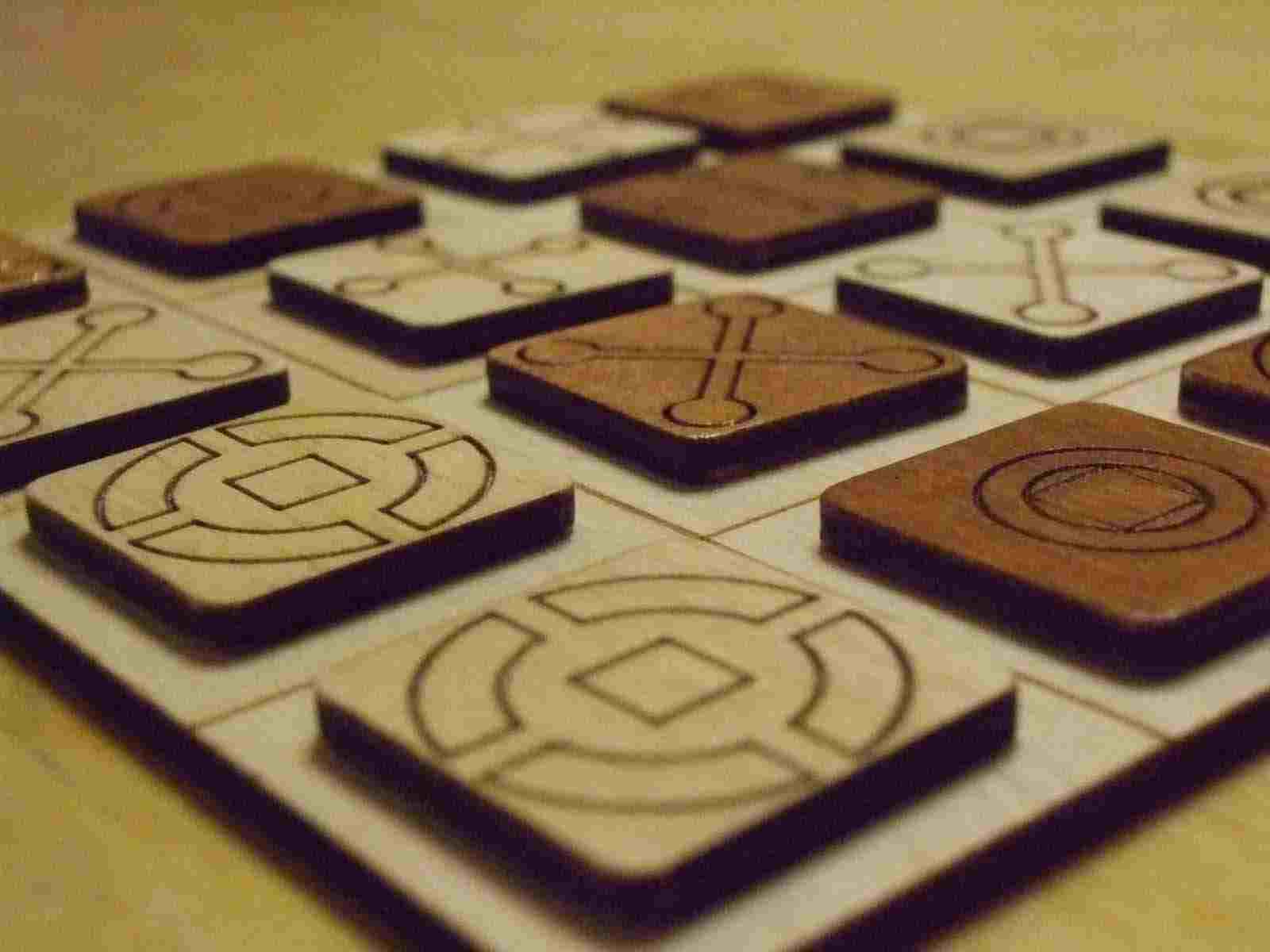
In Mijndlieff each player begins the game with 8 pieces of four different varieties (Straights, Diagonals, Pushers and, Pullers).
Straights: Your opponent's next piece must be placed in an empty square connected to this piece by a straight line.
Diagonals: Your opponent's next piece must be placed in an empty square connected to this piece by a diagonal line.
Pushers: Your opponents piece cannot be placed in any square that touches the square this piece is played into. This includes both straight and diagonal connections.
Pullers: Your opponents piece must be placed in a square that touches the
square this piece is played into. This includes both straight and
diagonal connections.
Winning
Once the last piece has been placed players score 1 point for every line of three that they have managed to lay and, 2 points for every line of four. The player with the most points wins the game.
Links