Showing posts with label Strategy. Show all posts
Tuesday, 5 February 2013
The Log: 50 Points of Efficiency
As well as playing the game well and, a fair amount of luck, a big part of victory in Heroclix like a lot of other collectible games involves choosing and fielding a "good" force.
But what makes a "good" force?
My initial thoughts on this where a flashback to my Magic: The Gathering days where if you stocked your deck with more Rare cards than your opponent you were distinctly more likely to win. On closer inspection though, I'm pretty sure that's not really the case with Heroclix.
This doesn't mean that you don't get a bit more bang for your buck with say a Rare clix model than you do from a Common one but, with models also being graded by their "experience" and, having all this tied up with a points cost, it seems far less important to only field Rare or Limited Edition models.
To put it another way, Rarity is no guarantee of quality and, the theory that I am currently working with is that the better forces are the ones that make the best use of the rules. We're not talking about loopholes here but the bare bones of the mechanics. Making use of factors such high defense scores boosted by Team Abilities and Abilities that make you virtually impossible and such.
Looking over the rules it is even possible to determine the most "efficient" point costing of a clix, which given the title of this post shouldn't surprise you when I say it's 50.
But why 50 points?
Well no matter the size of your fielded force you can take actions (excluding free actions)equal to the point cost divided by 100, with your basic actions being move and attack. Try to act with the same models two turns in a row though and they take damage (although some abilities can get around this) and, won't be able to do anything for the next turn.. Well, other than sit there waiting to get shot to pieces that is.
However, if you field 50 points models you can get around this completely. On one turn half of your models can act as the other half clear their action tokens as a freebie, who are then ready to act next turn, as this lot clear theirs.
Acting fully every turn seems like a great way to go from a newcomers point of view but, I do see that finding a handful of 50 point models you want to field might be a problem. I don't believe it's impossible though.. Just a challenge.
Wednesday, 18 July 2012
Thrift Store Finds
I have a reputation amongst my fellow gamers.
I'm lucky. REALLY lucky. Lucky to the point that whenever it comes to contesting dice rolls, someone around the table will remind whoever I am up against that they're rolling against me. As you can imagine, that is quite a reputation to have when it comes to gaming and, without any sense of ego I can say that it is well deserved.
I am lucky. REALLY REALLY lucky and, it doesn't end at the gaming table. I have made some pretty amazing finds in thrift stores over the past few months, so I thought I would take a moment to share a few of them with you, what they're actually worth and the pittance I paid for them.
The first great find this year was Gorkamorka. Not only was this game a limited production run but, the copy I found was for the most part untouched. The orks and what not had been assembled but, the books where virtually unread, the bulkheads that came with the set where still on sprue's and, the vast majority of the card-stock components where unpunched.
Approximate Value: £80ish.
I Paid: £10.
Inside that very same box there was also a sealed blister of metal Blood Bowl Chaos Cheerleaders, circa 1998.
Approximate Value: Hard to say as I have no frame of reference. There isn't even a similar item to be found on E-Bay. I would conservativly say in the ball park of £30 though.
I Paid: Nowt.
My next lucky find was Heroquest. I have wanted a copy of this for years, so there was no way in hell that I was going to leave that sitting on the shelf. Upon picking it off the shelf however I noticed that the box seemed to be bulging at the seams. What ever could be in here? Well there was only one way to find out given that it was all taped up. I bought it (like I said, no way in hell I was going to pass this one up. Especially with a mystery element attached).
When I got it home, JACKPOT! Not only was there a complete copy of Heroquest inside in good condition but, also the better part of three expansions! Sure, they may be missing a couple of miniatures all told and two or three card pieces but this was still an amazing find.
Approximate Value: £130.
I Paid: £4.99.
Only a week ago a thrift store dive uncovered 60 Lord of The Rings Miniatures for the tabletop skirmish game by Games Workshop. The most impressive aspect here for me was that the vast majority of those miniatures where metal and, included a close to complete fellowship.
Approximate Value: £35.
I Paid: £2.50.
Today was no exception to the rule either, turning up as I have Carcassone plus two expansions (one of which is unpunched).
Approximate Value: £20ish.
I Paid: £3.50.
Today also turned up a copy of a nice little abstract strategy game called Queen Bee. A little research has turned up the fact that this appears to be a first printing (by Condor), but little more. Either this little gem is remarkably unpopular or as rare as hens teeth. I suspect it may be the latter, making it an ideal candidate for a write up and review. It's also rules light, abstract strategy. Which is just awesome!
Approximate Value: Not a clue.
I Paid: 99p.
I'm lucky. REALLY lucky. Lucky to the point that whenever it comes to contesting dice rolls, someone around the table will remind whoever I am up against that they're rolling against me. As you can imagine, that is quite a reputation to have when it comes to gaming and, without any sense of ego I can say that it is well deserved.
I am lucky. REALLY REALLY lucky and, it doesn't end at the gaming table. I have made some pretty amazing finds in thrift stores over the past few months, so I thought I would take a moment to share a few of them with you, what they're actually worth and the pittance I paid for them.
The first great find this year was Gorkamorka. Not only was this game a limited production run but, the copy I found was for the most part untouched. The orks and what not had been assembled but, the books where virtually unread, the bulkheads that came with the set where still on sprue's and, the vast majority of the card-stock components where unpunched.
Approximate Value: £80ish.
I Paid: £10.
Inside that very same box there was also a sealed blister of metal Blood Bowl Chaos Cheerleaders, circa 1998.
Approximate Value: Hard to say as I have no frame of reference. There isn't even a similar item to be found on E-Bay. I would conservativly say in the ball park of £30 though.
I Paid: Nowt.
My next lucky find was Heroquest. I have wanted a copy of this for years, so there was no way in hell that I was going to leave that sitting on the shelf. Upon picking it off the shelf however I noticed that the box seemed to be bulging at the seams. What ever could be in here? Well there was only one way to find out given that it was all taped up. I bought it (like I said, no way in hell I was going to pass this one up. Especially with a mystery element attached).
When I got it home, JACKPOT! Not only was there a complete copy of Heroquest inside in good condition but, also the better part of three expansions! Sure, they may be missing a couple of miniatures all told and two or three card pieces but this was still an amazing find.
Approximate Value: £130.
I Paid: £4.99.
Only a week ago a thrift store dive uncovered 60 Lord of The Rings Miniatures for the tabletop skirmish game by Games Workshop. The most impressive aspect here for me was that the vast majority of those miniatures where metal and, included a close to complete fellowship.
Approximate Value: £35.
I Paid: £2.50.
Today was no exception to the rule either, turning up as I have Carcassone plus two expansions (one of which is unpunched).
Approximate Value: £20ish.
I Paid: £3.50.
Today also turned up a copy of a nice little abstract strategy game called Queen Bee. A little research has turned up the fact that this appears to be a first printing (by Condor), but little more. Either this little gem is remarkably unpopular or as rare as hens teeth. I suspect it may be the latter, making it an ideal candidate for a write up and review. It's also rules light, abstract strategy. Which is just awesome!
Approximate Value: Not a clue.
I Paid: 99p.
Links
Blood Bowl Board Game Geek Entry
Carcassonne Board Game Geek Entry
Gorkamorka Board Game Geek Entry
Heroquest Board Game Geek Entry
Lord of The Rings: Tabletop Battle Game Board Game Geek Entry
Tuesday, 17 July 2012
Play Report: Mijnlieff #1
As gamers we soon learn that there is a great difference between knowing the game and, playing the game. In my last post we took a good look at the former but, how does the theory work as practice?
Well one thing that I have certainly learned from play is that changing the board drastically changes the game. Now this may seem like an obvious point to bring up for those of us who have played games with variable boards before, like ZOMBIES!!!, Space Hulk, Dungeonquest and, The Legend of Drizzt to name but a few.
Mjinlieff differs however in that the shape of the board drastically alters the value of the pieces to you as a player. If for example you create a board with very few diagonal connections, then the diagonal pieces become worth a lot more to you because they place greater limitations on your opponent and the spaces that they can play into in response.
Something tells me that this is only the tip of the iceberg too.
This is certainly a game I expect to be playing a lot more of in the future as it's right up my street! Abstract, Strategy and, Rules light. Stay tuned for more reports as we see just how deep down the rabbit hole we can trek with this gem.
Well one thing that I have certainly learned from play is that changing the board drastically changes the game. Now this may seem like an obvious point to bring up for those of us who have played games with variable boards before, like ZOMBIES!!!, Space Hulk, Dungeonquest and, The Legend of Drizzt to name but a few.
Mjinlieff differs however in that the shape of the board drastically alters the value of the pieces to you as a player. If for example you create a board with very few diagonal connections, then the diagonal pieces become worth a lot more to you because they place greater limitations on your opponent and the spaces that they can play into in response.
Something tells me that this is only the tip of the iceberg too.
This is certainly a game I expect to be playing a lot more of in the future as it's right up my street! Abstract, Strategy and, Rules light. Stay tuned for more reports as we see just how deep down the rabbit hole we can trek with this gem.
Links
Boardgame Geek Entry
Order your copy here!
Quickstart: Mijnlieff
Overview
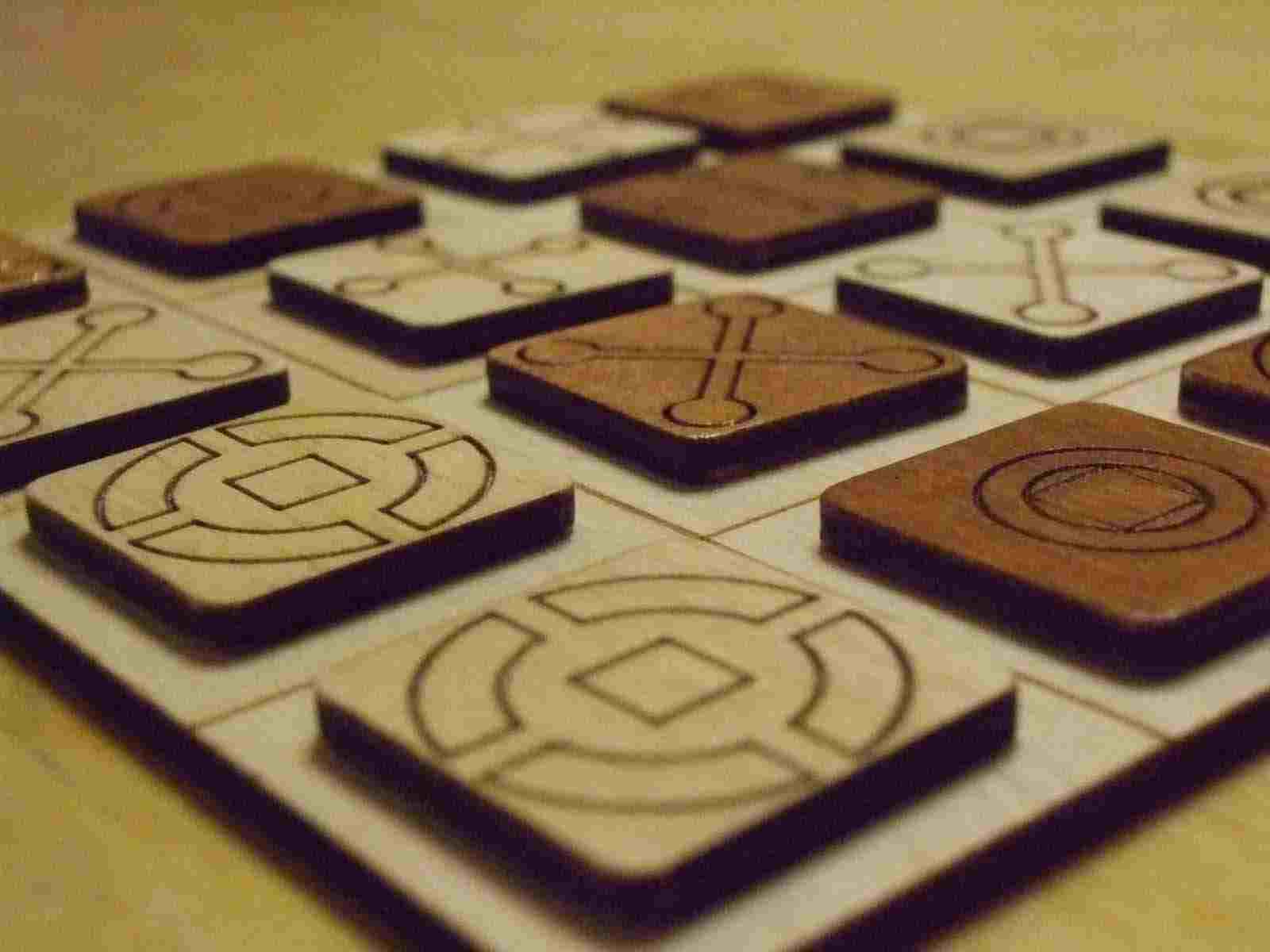
Mijnlieff (pronounced Mine-Leaf) is an abstract strategy game that definitely falls into the "Quick to learn, hard to master" category of games that I love so dearly. To boot, it's rules light, which is always a plus. So a quick flick through this guide should have you playing confidently in minutes.
The Game As It Is Played
Before play the four 2x2 boards are arranged in a pattern mutually agreed upon by both players. For your first game it is probably best to arrange them in a square as this is by far the easiest board to get to grips with.
Each player then takes the 8 pieces of their color and, like Chess, "White" (light in this case) pieces play first. The light player may now place any one of their pieces in any space on the board. Play then passes to the dark player.
The dark player may now play anyone of his pieces BUT is limited to where he may place it depending upon what the light player has played (see The Pieces below). Play then alternates between the two players in this fashion, with each move being limited by what your opponent played last.If at any point it is your turn but you cannot play a piece (because all of the legal spaces have already been occupied) you must pass. If you pass, your opponent may place their next piece in ANY free space.
Once a player has placed their last piece, their opponent gets one last chance to place a piece (which must be placed legally or the turn passed) before the scores are tallied (see Winning below).
The Pieces
In Mijndlieff each player begins the game with 8 pieces of four different varieties (Straights, Diagonals, Pushers and, Pullers).
Straights: Your opponent's next piece must be placed in an empty square connected to this piece by a straight line.
Diagonals: Your opponent's next piece must be placed in an empty square connected to this piece by a diagonal line.
Pushers: Your opponents piece cannot be placed in any square that touches the square this piece is played into. This includes both straight and diagonal connections.
Pullers: Your opponents piece must be placed in a square that touches the square this piece is played into. This includes both straight and diagonal connections.
Winning
Once the last piece has been placed players score 1 point for every line of three that they have managed to lay and, 2 points for every line of four. The player with the most points wins the game.
Links
Board Game Geek Entry
Order your copy here!
Monday, 9 July 2012
Even More On Logan Stones
A friend of mine has just posted up a nice little review of his first impressions of Logan Stones over at his blog.
Check it out here.
Like Logan Stones? Order your copy here.
Quickstart: Logan Stones
Overview
Logan Stones is a simple light-strategy game that combines elements of Connect 4, Othello and the playground classic Rock, Paper, Scissors. Don't be fooled by the relative ease of these component games or my description of Logan Stones as "light" however as the depth of play can be quite substantial, as can the level of challenge.
The Game As It Is Played
Logan Stones consists of 18 double-sided playing pieces (the Logan Stones) that depict one of three images (a rock symbol, a paper symbol and, a scissors symbol).
Before play these pieces are mixed in a bag (provided with the game). Two pieces are then removed from the bag and placed next to each other to form the starting set-up. The remaining pieces are then dealt out equally between the players.
The first player then places a stone of their choice so that it touches two stones already in play, flipping them if they are trumped by the stone placed. For example, placing a stone displaying a paper next to a stone displaying a rock will flip the rock. It is then the next players turn.If a player cannot place a stone (because they have run out) they must move a stone instead. They may move any stone as long as it does not leave a placed stone touching only one other stone. Moved stones are treated the same as placed stones and will trump a stone they are placed next to if at all possible (rock beats scissors, scissors beat paper and, paper beats rock).
Winning
The first player to connect any four (or more) matching symbols in a straight line wins.
Order your copy here!
Monday, 25 June 2012
Dominion: Winning your first game.
A bit about Dominion
Amongst all the card draft games on the market, i think it's safe to say that the popularity of Dominion is second to none.Well designed, beautifully executed and, with a wide range of ways to play it manages to offer both the depth that experienced gamers often desire without excluding newcomers to the scene.
Chances are though that if you're reading this you're no stranger to the game but, you may be having one or two problems bringing home your first win. That's okay though. By the end of this post you'll be on the fast track to victory, no matter the card set nor the scenario.
What makes a good card?
Whilst luck and timing play their parts in Dominion, most games will be won by building a superior deck (unsurprisingly). But what makes a good card? This will vary slightly from game-to-game but generally there are a few golden rules that won't steer you far wrong.1: Card draw.
Any card that allows you to draw more cards is generally going to be a good thing. Firstly this will give you a greater chance of pulling the coinage out of your deck, thus giving you more freedom over the cards that you can purchase. Card drawing also has the secondary effect of pulling victory cards into your hand.. Which means you won't be drawing them next turn. This becomes particularly important towards the end of a game when drawing a handful of victory cards may leave you unable to do a lot on your turn.2: Extra actions.
What's better than playing one card that allows you to draw more cards on your turn? Playing two or three of them!Extra actions are effectively extra turns and, there is nothing to stop you chaining enough of these together to cycle through your entire deck every turn if you've got the cards. The Village in the "First Game" setup is a prime example of this effect, replacing itself by allowing you to draw another card whilst allowing you to take two further actions, one of which could be another Village.
3: Multi-buy.
Last of the golden rules is that any card that gives you an extra buy is generally a good thing (provided that you don't use those buys to fill your deck with junk). A common problem that arises when playing Dominion (at least from personal experience) is that of generating 7 coinage on a turn when a Province costs 8.An extra buy however will let you pick up an Estate and a Duchy for 7, only falling one short of a Province in victory points. It's probably not a good idea to do this too often however as you'll soon find that picking up all of those extra Estate's will begin to clog up your deck.
Turning the golden rules into a strategy.
Following the golden rules above will help you weigh up the value of a card with relative ease but, for those that have been playing for a while, i've probably not really told you anything that you didn't already know.Well all being well that'll change in the next few sentences when i introduce the concept with which i approach all games, the buy list.
Coming from a background in CCG's deck construction is virtually second nature, with one of the lessons that i learned early on being that a fancy card here or there rarely does the trick. A good deck needs to be consistent and focus on whatever it has been designed to do.
Now whilst the obvious goal in Dominion is to accumulate the most victory points by the end of play, the strategy you employ to get there can be as varied as the cards at your disposal. The good thing is though that no matter the strategy, you can always use a buy list!
So what is a buy list?
All cards in play have a cost and a buy list allows you plan your whole game out from the word go.The first thing to do is to take the time to sit down, read each card and, then decide how you will play your game. For each value (say all the cards that cost 3 coinage), choose the card that best suits your strategy, whatever it may be.
If you need the extra coinage, it may be a piece of silver, if you need the extra actions and some card draw, it may be the Village. At any rate and however you'll play, choose one card in each value. This is your buy list and, it really is that simple.
Stick to this strategy (and indeed your strategy) and you won't go far wrong. Once you manage you've claimed your first few Province's you may want to switch your "5 buy" to Duchy's but, only if you're opponent has pulled a couple of Province's themselves. This is probably the only judgment call you'll have to make and, once you get that one down you'll be winning games left, right and, center.
Like Dominion? Get 10% off RRP here if you mention this blog!
Subscribe to:
Posts (Atom)